


2018 School Spending Survey Report
Historic Day for Candace Fleming
At the 2026 Youth Media Awards, author Candace Fleming became the first person to receive the Children’s Literature Legacy Award and the Margaret A. Edwards Award in the same year. In addition, her book Death in the Jungle won the Award for Excellence in Nonfiction for Young Adults.
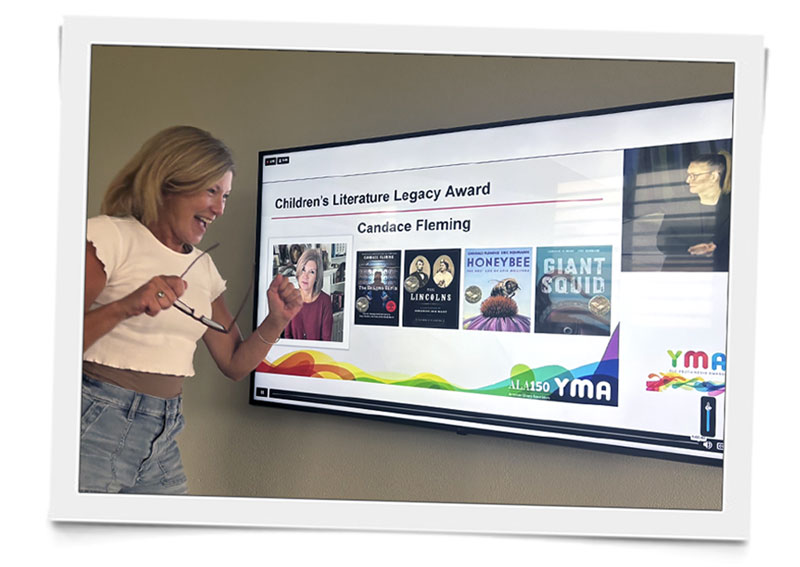
Every January, as the Youth Media Awards announcements approach, children’s literature creators dare to dream of getting that career-defining phone call. Author Candace Fleming received three. Then, in what she called the “24 hours of silence” between the Sunday conversations and the announcement of the Youth Media Awards on Monday, she couldn’t help but wonder if she had imagined it all.
But the recognition was real, and the day was historic.
Fleming was named the 2026 recipient of both the Children’s Literature Legacy Award and the Margaret A. Edwards Award. She is just the third person to win both— joining Jacqueline Woodson and Walter Dean Myers—and is the only person to receive both in the same year.
“I can’t wrap my hand around it,” Fleming said from Puerto Rico where she is on vacation with her family. “The imposter syndrome pops up. ‘What are these committees thinking? I’m just Candy Fleming. I am not one of those people.’”
In addition to the lifetime achievement recognition, on Monday her book Death in the Jungle won YALSA’s Award for Excellence in Nonfiction for Young Adults.
“I’m a little overwhelmed,” she said of the day’s honors. “I’m so unbelievably grateful and so unbelievably happy. I’m just still reeling.”
Fleming published her first book in 1994 and has since written more than 50 titles for children and teens, from picture books to YA, nonfiction and fiction. On Monday, she was recognized for the breadth and quality of that work.
The Legacy Award honors an author or illustrator whose books have made “a substantial and lasting contribution to literature for children through books that demonstrate integrity and respect for all children’s lives and experiences.” The Margaret A. Edwards recognizes an author for “lifetime achievement in writing for young adults.”
“I’ve been doing this work for 30 years, and trying to do the best that I can, trying to always think about my reader, whether it’s preschool and I’m writing Muncha! Muncha! Muncha! or it’s YA and I’m writing Death in the Jungle, I’m always thinking about my reader, trying to bring them something—if it’s just joy, a good laugh, or if it’s something that I want them to really think about history [and how] you hear echoes of it today,” she said.
“I am so grateful that these committee members actually recognize what I was trying to do all those years, recognize the hard work that I’ve put in, the love and care, the passion, the commitment that I’ve devoted to those books. Fifty other authors could say exactly the same thing—[they] have been out there a long time, they’re committed and dedicated and passionate and love young readers and want to give young readers the very best that they can—so I feel unbelievably lucky and unbelievably grateful and honored and joyful that I was plucked from those many amazing writers and illustrators out there.”
When the Edwards committee called her on Sunday, she cried. Then, when the Legacy committee called, she couldn’t hold back giddy laughter. She hung up, and the giggles turned to more tears.
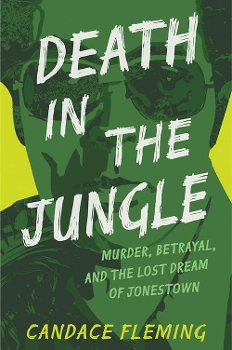 The Excellence in Nonfiction Award for Death in the Jungle was gratifying in a completely different way. She previously won the 2021 Sibert Medal for Honeybee: The Busy Life of Apis Mellifera, as well as the 2021 YALSA Excellence in Nonfiction Award for The Rise and Fall of Charles Lindbergh. But this one was different. She knew teens would be interested in the cult story but worried about how that book would be received overall.
“When I was done, when I sent it, I burst into tears,” Fleming recalled. “I was like, 'Oh, my God, people are going to be like, ‘Jim Jones for kids? Is she kidding? What does she think she’s doing?’”
When her first positive review came in, she was thrilled. It meant adults understood what she was trying to do, and positive reviews help get the books into the hands of kids. Teens, she knew, would be interested in this one.
“I think one of the big reasons that young adults don’t love nonfiction is I don’t think we give them subjects that appeal to them,” she said. “Instead, we often go, ‘Well, this is a topic that they should know about.’ But there is a lot that we can say to teenagers with topics that I think they would actually choose for themselves.”
Cults, she believed, would be one of those subjects.
“I thought, I’m going to write about cults,” she said. “I have no idea what I’m going to write about cults, but I was fascinated by them when I was in high school, and I know that high schoolers still are.”
After more research, she zeroed in on the story of Jim Jones and the Peoples Temple.
“There were a lot of things in the Peoples Temple that I think speak to teenagers of the 21st century,” she said. “There’s a lot in the story about groupthink and about peer pressure, and about both good influence and bad influence, about going along to get along, about charismatic leaders, about choosing to believe something even when you know that it’s not true.”
Fleming may have received recognition for her decades of work, but these awards do not signal a career’s end. Her research and writing will continue, with more of a sense of urgency than ever before.
“Right now, we don’tseem to be a country that’s doing a whole lot of critical thinking,” she said. “It seems like everything that I’m doing feels more necessary than it ever did before. Honestly, I feel like it’s become more pressing, at least for me. Let’s face it, we have this whole erasure of history going on. We have this struggle. It really is [a] reckoning. Whose story gets told? Whose story doesn’t get told?”
That isn’t new, she said, but she feels it more acutely now—it’s not just whose story will be told, but what part of those stories will be allowed? She learned from a librarian in Alaska that The Rise and Fall of Charles Lindbergh was removed from a public library branch.
“The fact that I can write less-than-heroic American history, and suddenly it’s banned...we don’t want to talk about that less-than-heroic history, much less any history that doesn't serve the state, which is scary to me,” she said. “So I will continue to do that work, because there’s really no other choice. Kids deserve the truth.”

Added To Cart
RELATED


RECOMMENDED
CAREERS
The job outlook in 2030: Librarians will be in demand
CAREERS
The job outlook in 2030: Librarians will be in demand
ALREADY A SUBSCRIBER? LOG IN
We are currently offering this content for free. Sign up now to activate your personal profile, where you can save articles for future viewing
ALREADY A SUBSCRIBER? LOG IN
Thank you for visiting.
We’ve noticed you are using a private browser. To continue, please log in or create an account.
Add Comment :-
Be the first reader to comment.
Comment Policy:
Comment should not be empty !!!